Kelowna vs Dallas: which should you move to?
Kelowna or Dallas? Housing, rent, crime, climate, income, taxes and transit, side by side, from each city's own published figures. Written for someone deciding where to live, not for a ranking.
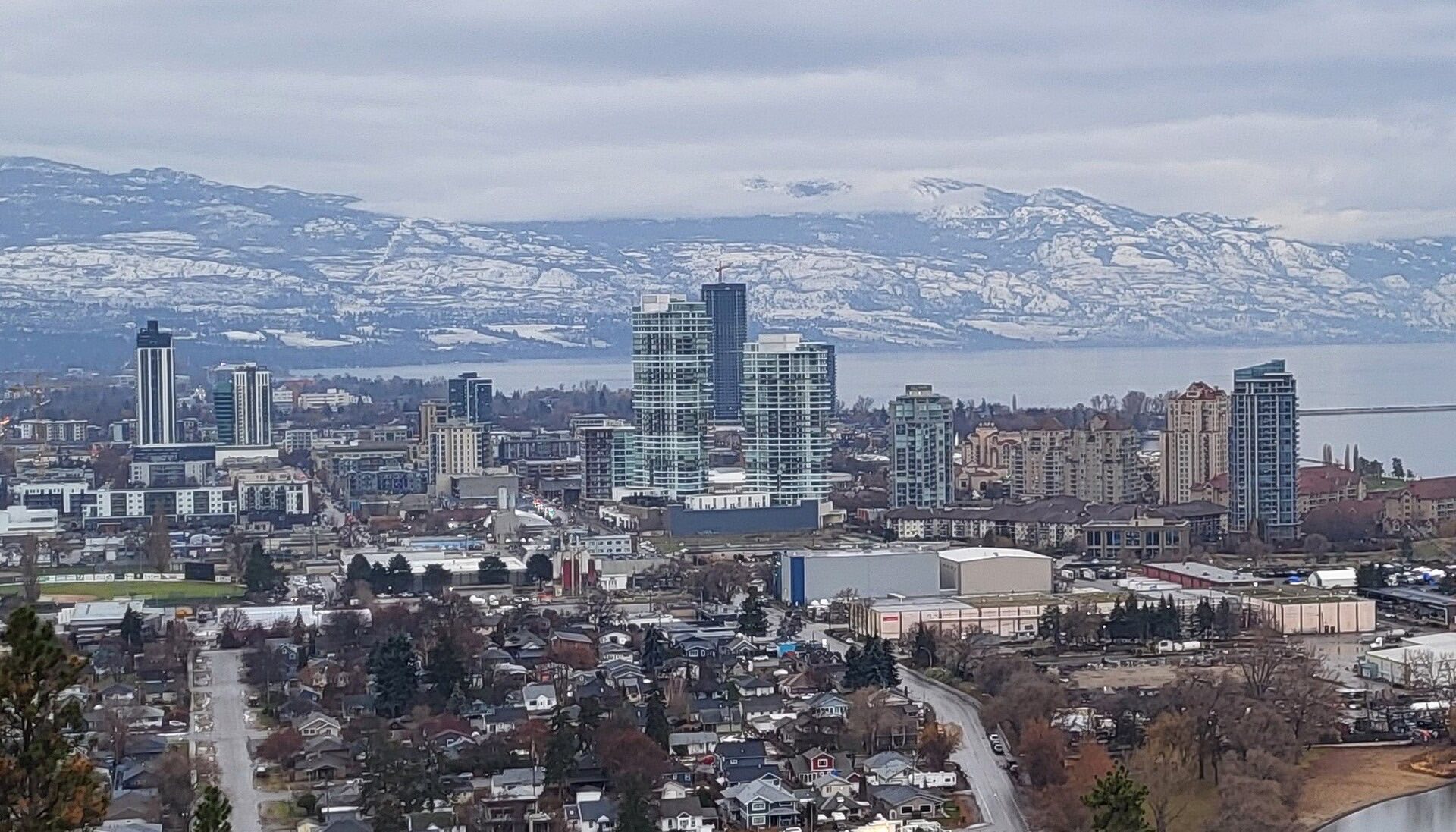
Kelowna
.jpg)

Dallas

The two housing bills are in different currencies, and held against local pay they are far apart. Mortgage, property tax and insurance come to about $5,262 CAD a month on Kelowna's single-family benchmark, roughly 74% of the metro's 2020 median household income, and about $3,529 USD on the Dallas single-family median, roughly 57% of the city's 2024 median, on houses that cost 12.6 and about 6.3 times those incomes. The tax sits in opposite places: a Kelowna earner pays about $20,500 CAD of $100,000 in federal and provincial income tax, while Texas levies none and collects $7,448 a year, an effective 1.58%, on the Dallas median house. Dallas has the labor market, 4.2% metro unemployment in July 2026 against 9.3% in Kelowna, the highest of any Canadian metro, and the airport, with 85,660,127 passengers at DFW in 2025 against 2,315,432 at YLW. Homicide favors Kelowna, 4 in the metro in 2025, about 1.58 per 100,000, against 140 in Dallas, about 10.5. Choose Kelowna if your income or equity comes with you and you want a dry 20.0 C July on a lake with coverage that comes with residency. Choose Dallas to find work and to buy a house on a salary.
Kelowna prices are in CAD and Dallas prices are in USD. The tables leave them in their own currency and compare ratios and rates instead; a conversion would be stale by the time you read it.
| Measure | Kelowna | Dallas | Advantage |
|---|---|---|---|
| City population | 166,278 (2026) | 1,329,491 (2025) | Not directly comparable |
| Metro population | 222,162 (2021) | 8,477,157 (2025) | Not directly comparable |
| Five-year growth Growth is pressure on rents and roads as much as it is opportunity, so it is reported without a winner. | 13.5% (2016-2021) | 1.9% (2020-2025) | Not directly comparable |
What a home costs in each
The figures the two cities' rent-versus-buy and mortgage calculators run on, read from the same tables.
| Measure | Kelowna | Dallas | Advantage |
|---|---|---|---|
| Benchmark home price MLS® HPI or equivalent benchmark. Lower is treated as the advantage, which is the buyer's view rather than the owner's. | $1,072,400 (July 2026) | $469,900 (August 2026) | Not directly comparable |
| Detached house benchmark Kelowna and Dallas publish a single house index rather than a composite, so the two rows repeat. | $1,072,400 | $469,900 | Not directly comparable |
| Apartment or condominium benchmark | $490,700 | $310,000 | Not directly comparable |
| Two-bedroom rent | $2,132/mo (average, October 2025) | $1,853/mo (average, August 2026) | Not directly comparable |
| One-bedroom rent | $1,600/mo | $1,416/mo | Not directly comparable |
| Two-bedroom rent against median income A year of two-bedroom rent as a share of the median household income below. A household paying the median rent out of the median income is a fiction, but it is the same fiction in both columns and it crosses currencies. | 30.1% of a year's income | 29.9% of a year's income | Dallas |
| Mortgage payment on the benchmark, 20% down 25 years in Kelowna against 30 in Dallas, each compounding the way its own country's lenders do. The rates are not a spread you can shop: they are what each market charges. | $4,672/mo at 4.34% | $2,509/mo at 7.03% | Not directly comparable |
| Price to household income Benchmark price divided by the median household income below. A ratio is comparable across currencies; the dollars are not. | 12.6× | 6.3× | Dallas |
| Property tax on the benchmark home The effective rate on market value, which is what the two rates have in common and what the Advantage column is decided on; the bills are in each city's own dollars. | $5,104/yr (0.476%, 2026) | $7,448/yr (1.585%, 2025) | Kelowna |
| Transfer tax on the benchmark home Compared as a share of the price. Where the seller pays it, it is a cost of leaving rather than arriving. | $19,448 (buyer pays) | None | Dallas |
| Rent control A cap protects a sitting tenant and does nothing for the next lease, so neither column is simply better. | 2.3% guideline (2026) | Forbidden by state law | Not directly comparable |
Kelowna: The 2026 Class 1 residential total of $4.7595 per $1,000 of taxable value: municipal $2.9615 plus the regional district, hospital, school, BC Assessment and MFA levies, before the Home Owner Grant, and before parcel taxes and utility user fees. Dallas: About 1.58% of value for a homesteaded owner, worked out on the $469,900 median single-family sale price. A house in the City of Dallas and Dallas ISD is taxed by five units for 2025, which add to 2.22671 per $100 before any exemption. Each takes its own homestead exemption off the appraised value first: Dallas ISD the state's $140,000 and a further 10% of its own, and Dallas County, the City, Dallas College and the Parkland Hospital District 20% each. So Dallas County levies 0.2155 per $100 on $375,920 after a $93,980 exemption, $810; City of Dallas levies 0.6988 per $100 on $375,920 after a $93,980 exemption, $2,627; Dallas ISD levies 0.993835 per $100 on $282,910 after a $186,990 exemption, $2,812; Dallas College levies 0.106575 per $100 on $375,920 after a $93,980 exemption, $401; Parkland Hospital District levies 0.212 per $100 on $375,920 after a $93,980 exemption, $797. The five come to $7,446 a year, 1.58% of the price. Without a homestead, as a landlord or a buyer who never files, the same house owes $10,463. The appraisal district's own typical homestead is cheaper than the typical sale: its certified median market value for a City of Dallas homestead was $364,530 for the 2025 appraisal year, the value on 1 January 2025 these rates were levied on, and $364,000 for 2026. On $364,530 the same five units come to $5,465, 1.50%, lower because the school district's flat exemption is a larger share of a cheaper house. These are the 2025 rates, the bills due by 31 January 2026. The appraisal district's 2026 table was still its estimate of 4 March 2026 when these figures were retrieved, so the calculators stay on 2025 until the five units' 2026 rates are published.
How safe each city is, by the numbers it publishes
Police-reported figures for the most recent year each force or statistics agency has released. Rates describe a whole city or metro area, and the spread between neighbourhoods inside one city is usually wider than the gap between the two cities.
| Measure | Kelowna | Dallas | Advantage |
|---|---|---|---|
| Crime Severity Index Statistics Canada's weighted index for the metropolitan area, where 100 is Canada in 2006. American cities have no equivalent series. | 103.7 (2025) | Not published | Not directly comparable |
| Violent crime per 100,000 Canada counts every violent Criminal Code incident; the FBI counts four offences. The Canadian figure is always the larger one for that reason alone. | 1,872 (2025) | 577 (2025) | Not directly comparable |
| Property crime per 100,000 | 4,749 (2025) | 3,081 (2025) | Not directly comparable |
| Homicides Counts, not rates, and a single year in a small city moves a long way on chance alone. What each figure covers is under the table. | 4 (2025) | 140 (2025) | Not directly comparable |
The Kelowna CMA's Crime Severity Index has fallen four years running, from 126.03 in 2022 to 119.56 in 2023, 107.49 in 2024 and 103.68 in 2025, and its rank among CMAs dropped from second in 2022 to ninth in 2025. Most of the decline is in non-violent crime (128.98 in 2021 to 105.25 in 2025); the violent index has barely moved (104.48 to 101.94), and a May 2026 City of Kelowna citizen survey found one in four residents feel unsafe.
What the rates cover: Police-reported total violent Criminal Code violations per 100,000, Kelowna CMA, table 35-10-0177-01. 2024: 1,897.16; 2021: 1,947.46.
Homicides: Kelowna CMA homicide victims, table 35-10-0071-01, rate 1.58 per 100,000. 2024: 2 (0.80); 2023: 5 (2.04); 2022: 8 (3.36).
On the FBI's definitions, violent offenses in Dallas went from 11,181 in 2021 to 10,255 in 2022, 9,025 in 2023, 8,747 in 2024 and 7,674 in 2025, a 12% drop in the last year and 31% in four, and property offenses from 46,991 to 49,224, a peak of 52,641 in 2023, then 45,106 and 40,962, 22% below the peak. Motor vehicle theft drove most of that swing: 11,818 in 2021, 18,457 in 2023 and 11,162 in 2025. In 2025 the CDE shows aggravated assaults down 12% (5,826 to 5,144), robberies down 10% (2,235 to 2,020), rapes down 27% (505 to 370) and murders down 23% (181 to 140). On its own definitions DPD reported violent crime down 12%, robberies down 10%, aggravated assaults down 12% and sexual assaults down 13%. The 2025 CDE counts were read on 27 September 2026 from a feed last refreshed on 15 September and can still be revised.
What the rates cover: Computed: 7,674 violent offenses (murder, rape, robbery and aggravated assault) in the FBI Crime Data Explorer's summarized data for the Dallas Police Department (ORI TXDPD0000) in calendar 2025, divided by the 1,329,491 Vintage 2025 city population. On the CDE's own agency population of 1,331,217 the rate is 576. DPD does not publish a total on this definition. The violent crime its Violent Crime Reduction Plan tracks is murder, robbery and aggravated assault, with family-violence and other aggravated assaults counted separately and rape left out. Its public incident dataset on Dallas OpenData, which the city describes as a research copy rather than the authoritative count, lists only 57 murder incidents and 12 family-violence aggravated assault incidents for 2025, so it cannot rebuild either total.
Homicides: 140 murders and nonnegligent manslaughters in 2025 in the FBI CDE, against 181 in 2024, about 10.5 per 100,000 on the city population. DPD's own year-end count was 141 homicides against 184 in 2024, a 23% drop (CBS Texas, February 2026); nothing fetched explains the gaps of one and three cases between the two series. The high point in the CDE series since 2021 is 244, in 2023.
Winters, summers and what the weather can do to a house
| Measure | Kelowna | Dallas | Advantage |
|---|---|---|---|
| January mean | -2.6 °C | 8.8 °C | Not directly comparable |
| July mean | 20.0 °C | 30.7 °C | Not directly comparable |
| Precipitation a year | 387 mm | 973 mm | Not directly comparable |
| Snowfall a year | 89 cm | 4 cm | Not directly comparable |
| Sunshine a year | 1,949 hours | 2,850 hours | Dallas |
Temperatures are Environment Canada 1991-2020 normals for the composite KELOWNA station (climate ID 1123939, airport site at 49 57 N 119 22 W, 433 m). The 1991-2020 tables for that station publish precipitation only for September, so precipitation, snowfall and sunshine are the 1981-2010 normals for KELOWNA A (climate ID 1123970). Summers are dry and hot (20.0 C July mean), winters cloudy and mild for the interior.
Hazards: Wildfire and summer smoke are the defining hazard: the August 2023 McDougall Creek fire jumped Okanagan Lake, put about 35,000 people under evacuation order, destroyed or damaged 189 structures and caused about $480 million in insured losses; most summers bring days of smoke from fires elsewhere in the interior. Spring freshet flooding along Okanagan Lake and Mill Creek (2017) and heat (June 2021 heat dome) are the others.
NOAA NCEI 1991-2020 normals for Dallas Love Field (station USW00013960), the city's own climate station about 6 miles northwest of downtown: January mean 47.8F, July mean 87.3F, annual mean 68.0F, 38.32 in of precipitation, 1.7 in of snow. July and August tie as the warmest months at 87.3F, with mean highs of 96.9F and 97.1F, and January's mean low is 37.9F. October (4.79 in) and May (4.57 in) are the wettest months and July (1.71 in) the driest, and most of the snow falls in February (0.9 in). The normals count 107.5 days a year at 90F or above, 22.4 at 100F or above and 23.1 nights at or below freezing. Dallas Fort Worth International Airport (USW00003927), where the National Weather Service keeps the metro's official record, averages 46.3F in January and 85.7F in July with 37.01 in of rain and 1.6 in of snow, 20.3 days at 100F or above and 29.2 nights at or below freezing. Converted here to 8.8 C, 30.7 C, 973 mm and 4.3 cm. That July mean is the warmest of any city this site compares, 1.5F (0.8 C) above Austin's at Camp Mabry. Sunshine hours are the older 1961-1990 NCDC means (2,850 hours, 61% of possible), since the 1991-2020 normals do not include sunshine.
Hazards: Heat is the constant. The normals give Love Field 22.4 days a year at or above 100F (37.8 C); its record since 1939 is 73 such days in 2011, including 40 in a row from 2 July to 10 August, and its highest reading is 112F (44.4 C), on 26 and 27 June 1980 and again on 22 July 2018. At DFW Airport the record is 71 days in 2011 and the longest run 42, from 23 June to 3 August 1980, when the airport reached 113F (45.0 C). The summer of 2026 is among the hottest on record: by 22 September Love Field had 54 days at 100F or above, fourth in its record, and DFW 52, tied for fifth, 27 of them in August. Hail is the costly routine hazard. NOAA's billion-dollar disaster list counts a North Texas hailstorm on 23 and 24 March 2016 at $2.06 billion in 2016 dollars, and on 11 April 2016 a supercell dropped hailstones up to 5.25 in (13.3 cm), the record for the NWS Fort Worth area, and hit 80% of the homes in Wylie, northeast of the city; Cotality counted more than 235,000 Texas homes hit by damaging hail in 2025, far more than in any other state. Tornadoes reach the city itself. On 20 October 2019 an EF3 with winds near 140 mph (225 km/h) tracked 15.76 miles (25.4 km) from near I-35E and Walnut Hill Lane through Preston Hollow to US 75 and on into Richardson, damaging a high school, a middle school and an elementary school, destroying about 118 structures and doing $1.55 billion of damage without a death; on 26 December 2015 an EF4 killed 10 people in Sunnyvale, Garland and Rowlett in eastern Dallas County. The Trinity River passes downtown between 23 miles (37 km) of levees 29 to 32 ft (8.8 to 9.8 m) high, completed in 1932 and upgraded by the Army Corps of Engineers in the 1950s. The river's record crest at Dallas, 52.6 ft (16.0 m), came in the flood of May 1908, before them; the highest since was 47.1 ft (14.4 m) in May 1990, and by November 2023 the Corps had raised the West levee to carry 277,000 cubic feet (7,844 cubic meters) a second, with the East levee still to do. Flash floods on the creeks are the more frequent danger: on 21 and 22 August 2022, 9.19 in (233 mm) fell at DFW Airport in 24 hours, second only to 9.57 in (243 mm) in September 1932, 9.14 in (232 mm) fell at Love Field and 15.16 in (385 mm) at a gauge on White Rock Creek at Scyene Road, and at least one person died. Cold is rare and badly handled when it comes. Winter Storm Uri left 5.3 in (13.5 cm) of snow at Love Field from 14 to 17 February 2021 and a low of 2F (-16.7 C) on the 16th, matched there only in January 1949 and beaten only in January 1940 (0F, -17.8 C) and December 1989 (1F, -17.2 C); DFW Airport fell to -2F (-18.9 C), the lowest in its record since 1953. ERCOT cut power across the state grid from 15 to 18 February and about 4.5 million customers lost it at the worst; Texas counted 246 deaths from the storm, 22 of them in Dallas County. In January 2026 Winter Storm Fern brought 2.4 in (6.1 cm) of snow and sleet to DFW Airport and lows of 13F (-10.6 C), and the grid held. Drought is the slow hazard. The seven water supply lakes the Texas Water Development Board counts for the Dallas area stood at 86.5% of conservation capacity on 27 September 2026, down from 98.7% at the end of June; in the 2011 to 2015 drought they fell to 62.7% before the rains of 2015 filled them. Dallas has capped lawn watering at twice a week since April 2012.
What people earn and what the government takes
| Measure | Kelowna | Dallas | Advantage |
|---|---|---|---|
| Median household income | $85,000 CAD (2020) | $74,323 USD (2024) | Not directly comparable |
| Unemployment rate Statistics Canada and the Bureau of Labor Statistics define unemployment slightly differently; the Canadian measure runs about a point higher on the same labour market. | 9.3% (July 2026) | 4.2% (July 2026) | Not directly comparable |
| Sales tax | 12% | 8.25% | Dallas |
| Top marginal income tax Federal plus provincial or state. The American figure leaves out payroll taxes and the cost of health insurance, both of which a Canadian household covers through the tax it pays here. | 53.5% | 37% | Dallas |
| Income tax on $100,000, single filer Computed from each jurisdiction's brackets at a single filer's $100,000 and rounded to the dollar, so a gap of a dollar is rounding rather than tax. Two cities in one province or state are shown as Even, because there the two cells describe the same tax and whatever separates them is method. | $20,500 CAD | $13,449 USD | Not directly comparable |
Health care, retail and construction together account for about 41% of regional jobs, and tourism output reached $2.4 billion with 12,630 jobs in 2022. The Okanagan tech sector counted 787 companies and 32,645 jobs with a $4.98 billion economic impact in 2023 (Accelerate Okanagan/KPMG), but the CMA has carried the highest unemployment rate in Canada through spring and summer 2026 as the labour force has grown faster than jobs.
Main sectors: Health care and social assistance, Retail trade, Construction and real estate, Tourism and hospitality, Technology.
BC also levies a speculation and vacancy tax and an additional property transfer tax for foreign buyers in the Central Okanagan; MSP premiums were abolished in 2020, replaced by an employer health tax.
BLS counted 4,353,400 nonfarm jobs in the Dallas-Fort Worth-Arlington MSA in July 2026 (not seasonally adjusted), up 54,000 or 1.3% on the year. Professional and business services (+3.0%, to 805,200) and leisure and hospitality (+3.0%) grew fastest, then mining, logging and construction and education and health services (both +2.0%), while information (-2.8%), financial activities (-1.0%) and manufacturing (-0.7%) shrank. Trade, transportation and utilities is the largest sector at 895,000 jobs, and government employs 465,400. The seasonally adjusted series (FRED DALL148NA) was 4,363,400 in August 2026, 1.1% above August 2025. Average weekly wages across the metro were $1,785 in the first quarter of 2026 against $1,654 nationally. The Dallas Regional Chamber counts 21 Fortune 500 headquarters in the region as of 2025 and 44 in the Fortune 1000, among them AT&T, Texas Instruments, American Airlines, Kimberly-Clark, Toyota Motor North America and McKesson.
Main sectors: Trade, transportation and utilities, the metro's largest sector (DFW Airport, American Airlines, Southwest Airlines, BNSF Railway), Corporate headquarters and professional and business services (AT&T, Texas Instruments, McKesson, Kimberly-Clark, Toyota Motor North America), Financial activities (the Federal Reserve Bank of Dallas, Charles Schwab, JPMorgan Chase, Goldman Sachs, Bank of America), Health care and education (Baylor Scott & White Health, Texas Health Resources, UT Southwestern Medical Center, Children's Health), Aerospace and advanced manufacturing (Lockheed Martin, Bell Textron, Raytheon, Texas Instruments).
Property tax is the local levy that matters. Tax Foundation puts Texas's effective property tax rate on owner-occupied homes at 1.40%, and school districts must exempt $140,000 of a homestead's value from their tax. The City of Dallas's own rate for the fiscal year that starts on 1 October 2026 is 69.78 cents per $100 of taxable value, down from 69.88 cents, the eleventh cut in a row, in a $5.66 billion budget. Proposition U, a charter amendment Dallas voters approved in November 2024, requires the council to put at least half of each year's revenue growth into the Dallas Police and Fire Pension System, with any remainder of that half going to police pay and to a force of at least 4,000 officers; the budget adopted in September 2026 funds 3,651 officers by the end of September 2027 and 3,800 a year later. The county, school district and other levies on the same bill belong to the housing layer.
Whether you need a car
| Measure | Kelowna | Dallas | Advantage |
|---|---|---|---|
| System | Kelowna Regional Transit System (BC Transit, operated with the City of Kelowna, West Kelowna, Lake Country, Peachland and the regional district) | DART buses (nearly 700 vehicles), four light rail lines on 93 miles of track, the 26-mile Silver Line commuter rail from Plano to DFW Airport (opened October 2025), the Trinity Railway Express to Fort Worth run with Trinity Metro, the Dallas Streetcar and GoLink on-demand zones | Not directly comparable |
| Commute by public transit | 4.0% (2021) | 2.0% (2024) | Kelowna |
| Walk or cycle to work | 9.1% (2021) | 2.5% (2024) | Kelowna |
| Airport | Kelowna International Airport (YLW), city-owned; 2,315,432 passengers in 2025, up 8.5% on 2.13 million in 2024, ninth busiest airport in Canada. | Dallas Fort Worth International Airport (DFW), 85,660,127 passengers in 2025, 2.5% fewer than 2024's 87,817,864, per the airport's December 2025 traffic report; 12.65 million of them were international and American Airlines carried 82.6%. ACI World ranked it the fourth-busiest airport in the world by passengers in 2025 and third by aircraft movements. Dallas Love Field (DAL), about 6 miles northwest of downtown and the birthplace and headquarters of Southwest Airlines, handled 16,899,203 passengers in 2025, 5.5% fewer than in 2024 (FAA figures as cited by Wikipedia; the airport's website refused the fetcher). | Not directly comparable |
6.45 million rides in 2024 (up 330,000 on 2023), forecast 6.6 million for 2025 on about 219,000 service hours; more than 15,000 additional hours started January 2026 and another 12,380 are approved for 2027.
DART carried 52,823,800 unlinked trips in 2025, 28,151,100 of them by bus and 21,611,600 on light rail, and about 157,300 a weekday in the second quarter of 2026, 65,300 of them on light rail (APTA ridership reports, as cited by Wikipedia; APTA's PDFs refused the fetcher). DART's own figure is more than 171,000 passengers a day across a 700-square-mile, 12-city service area. The Trinity Railway Express, which DART runs with Fort Worth's Trinity Metro, carried 1,337,600 trips in 2025 (APTA, same source). The Silver Line opened on 25 October 2025 through Plano, Richardson, Dallas, Addison, Carrollton, Coppell and Grapevine to DFW Airport, every 30 minutes at weekday peaks and hourly otherwise. DART is paid for by a 1% sales tax in its member cities, and the suburbs have pushed back on what they pay: Plano, Irving and Farmers Branch canceled withdrawal elections set for May 2026 after agreements that return part of their sales tax over six years for local transportation projects, Addison and University Park voted to stay, and Highland Park voted by 70% to leave, with service ending on 14 May 2026.
Health care, schools and what each city is like
Health care
Care is publicly funded through the BC Medical Services Plan (no premiums since 2020) and delivered by Interior Health; Kelowna General Hospital is the interior's tertiary referral hospital with cardiac surgery and cancer care on site (BC Cancer Kelowna). Access is the problem rather than cost: KGH closed its pediatric unit for at least six weeks in May 2025 and curtailed neurology in January 2026 for lack of specialists, obstetricians warned of a collapse in primary maternity coverage, and finding a family doctor typically means a long wait on the provincial Health Connect Registry.
Education
UBC Okanagan (opened 2005, now roughly 12,000 students, with a record domestic intake of more than 3,000 new students in September 2025) and Okanagan College (about 5,200 FTE students across the valley) are the post-secondary anchors. Public schooling is School District 23 Central Okanagan, one of BC's fastest-growing districts, with French immersion and a few independent schools; there is no magnet or charter system.
Living there
Kelowna is a lake-and-orchard city of about 166,000 stretched along the east shore of Okanagan Lake, with a compact downtown, sprawling hillside subdivisions and a single bridge to West Kelowna that jams every afternoon. Summers are hot and dry and built around the beach, boats and the wineries; they also come with wildfire smoke, and the 2023 McDougall Creek fire is still a fresh memory. Housing costs are high for local wages, the unemployment rate led the country in 2026, and crime severity, though falling since 2022, is still well above the national figure.
Health care
Care is paid for through employer or marketplace insurance, Medicare and Medicaid, and Texas is one of the ten states that have not expanded Medicaid under the Affordable Care Act (KFF, August 2026). It had the highest uninsured rate of any state in 2024: 16.7%, or 5,152,427 of 30,799,312 people, against 8.2% nationally and 12.0% in Georgia, the next highest, on the ACS 2024 1-year estimates. The City of Dallas's rate was 22.7% (297,684 of 1,313,770), Dallas County's 21.9% and the metro's 16.2%. Parkland Memorial Hospital, licensed for 983 beds, is Dallas County's only public hospital and UT Southwestern's primary teaching hospital; it became the first certified Level I trauma center in Texas in 1983 and runs a burn center. UT Southwestern Medical Center, whose faculty have received six Nobel Prizes, runs William P. Clements Jr. University Hospital in the Southwestern Medical District, and more than half the doctors practicing in Dallas trained there at least in part. Baylor University Medical Center, which opened in 1903 and is now the North Texas flagship of Baylor Scott & White Health, has 914 beds and a Level I trauma center that Baylor Scott & White describes as one of only three adult trauma centers in Dallas. Children's Health and UT Southwestern broke ground in October 2024 on a $5 billion pediatric campus with 552 beds to replace Children's Medical Center Dallas, projected to open in 2031. This file did not verify a wait time figure for primary or specialist care.
Education
Dallas ISD, the second-largest school district in Texas, opened the 2026-27 year on 11 August with about 132,000 students, down from about 134,300 a year earlier (KERA). Superintendent Stephanie Elizalde blamed federal immigration policy in part. KERA adds that charter schools and the state's new education savings accounts may account for some of the loss; more than 2,800 students in the district had qualified for the accounts, which help pay private school tuition, on the Comptroller's latest count. The district made pre-kindergarten free for all 3- and 4-year-olds this year and enrolled about 11,000 children in it, and the Texas Education Agency rated the district B for 2025. Southern Methodist University (12,544 students in fall 2025) is in University Park, a separate town north of downtown, the University of Texas at Dallas is in Richardson, and Dallas College runs seven campuses in Dallas County.
Living there
Dallas is the corporate and financial center of the fourth-largest metro in the country, and the metro is growing around the city rather than inside it. The Dallas-Fort Worth area added 123,557 people in 2024-25, more than any metro but Houston, while the city lost 1,808 and Dallas County lost 46,226 more residents to the rest of the country than it gained, so newcomers settle in Collin, Denton and Kaufman counties. The city has 93 miles of DART light rail and, since October 2025, a commuter line to DFW Airport, yet 68.6% of its workers drive alone and 2.0% take transit. Summer is the hard season: the July mean at Love Field is 87.3F, the warmest of any city this site compares, and the station had 54 days at 100F or more by late September 2026. Hail and tornadoes are the costly weather. Texas takes no income tax, and 22.7% of the city's residents have no health insurance. The open question is whether the city can hold up its end as the region spreads outward: three suburbs won back part of the sales tax they pay DART and a fourth voted to leave, voters wrote a minimum of 4,000 police officers into the charter in 2024 and the adopted budget plans for 3,800 by September 2028, and Dallas ISD began 2026-27 with about 2,300 fewer students than the year before.
Where each city wins, and where it loses
Kelowna's figures are in Canadian dollars and Dallas's in US dollars. Kelowna's single-family benchmark for the Central Okanagan was $1,072,400 CAD in July 2026, 2.3% above a year earlier. The Dallas price is the NTREIS median sale price of single-family houses, $469,900 USD in August 2026, 6.0% below a year earlier. House against house, Kelowna's is 12.6 times the metro's 2020 median household income of $85,000 CAD and Dallas's about 6.3 times the city's 2024 median of $74,323 USD. At 20% down, Kelowna's mortgage at 4.34% is $4,672 CAD a month over 25 years, and Dallas's $375,920 loan at Freddie Mac's 7.03% of 24 September 2026 about $2,509 USD over 30. Property tax is 0.48% of price in Kelowna, $5,104 CAD a year, against $7,448 USD, an effective 1.58% with a homestead and $10,463 without. With insurance at $165 CAD and $400 USD a month, the owners carry about $5,262 CAD and $3,529 USD, roughly 74% and 57% of local median income. A two-bedroom averaged $2,132 CAD in October 2025 and $1,853 USD in August 2026, about 30% of local median income in both. Only British Columbia caps the increase on an existing tenancy, at 2.3% for 2026.
Homicide is the one count that crosses the border intact, and it favors Kelowna, with a caveat about territory: Kelowna's figures cover the metro and Dallas's the city of 1,329,491. The Kelowna metro recorded 4 homicide victims in 2025, 1.58 per 100,000. Dallas recorded 140 in the FBI's file, about 10.5 per 100,000, and 141 on the police count, against 184 in 2024. The other rates are different instruments. Statistics Canada put the Kelowna metro's 2025 Crime Severity Index at 103.68 against a national 75.0, ninth highest of 41 metros; American cities have no equivalent. Kelowna's violent rate of 1,872 per 100,000 counts every violent Criminal Code violation, common assault and uttering threats included. Dallas's 577 is 7,674 offenses of murder, rape, robbery and aggravated assault, divided by the Census estimate, because the department's own measure leaves rape out. Property crime, 4,749 per 100,000 against 3,081, is defined differently too. Kelowna's index has dropped four years running from 126.03 in 2022, though a May 2026 city survey found one resident in four feels unsafe, and Dallas's violent offenses dropped 12% in 2025 and 31% in four years. The Dallas counts, read on 27 September 2026, can still be revised.
Dallas has the mild winter and Kelowna the mild, dry summer. January averages 8.8 C at Love Field and -2.6 C at Kelowna's airport; July averages 30.7 C in Dallas, the warmest July mean of the fourteen cities this site compares, against 20.0 C in Kelowna. Dallas gets 973 mm of precipitation a year and 4.3 cm of snow, Kelowna 386.9 mm and 89 cm on its 1981-2010 normals. Love Field's normals count 22.4 days a year at or above 100F (37.8 C), and 2026 had 54 by 22 September. Kelowna's defining hazard is fire: the August 2023 McDougall Creek fire jumped Okanagan Lake, put about 35,000 people under evacuation order and caused about $480 million in insured losses, and most summers bring days of smoke. Spring freshet and heat like the June 2021 dome are the others. Dallas's costly routine hazard is hail, with stones up to 5.25 in (13.3 cm) in April 2016, and tornadoes reach the city itself, as the October 2019 EF3 did, with $1.55 billion of damage. Cold is rare and badly handled: Winter Storm Uri brought 2F (-16.7 C) to Love Field in February 2021 while ERCOT cut power across the state grid.
The labor markets are in opposite condition. The Kelowna metro's unemployment rate was 9.3% in July 2026 on a three-month average, the highest of any Canadian metro for a fourth straight month. Its labor force has grown faster than its employers hire, in a market where health care, retail and construction are about 41% of regional jobs. The Dallas-Fort Worth metro's rate was 4.2%, seasonally adjusted, on 4,353,400 nonfarm jobs, 1.3% more than a year earlier, and the region counts 21 Fortune 500 headquarters. Average weekly wages around Dallas were $1,785 in the first quarter of 2026 against $1,654 nationally. Median household income was $85,000 CAD in the Kelowna metro in 2020 and $74,323 USD in Dallas in 2024. British Columbia levies a provincial income tax, so $100,000 pays about $20,500 CAD before about $4,900 of CPP and EI, with a top combined rate of 53.5% and 12% on purchases. Texas levies none, so the same salary pays $13,449 USD in federal tax for 2025; the top rate is the federal 37% and sales tax is 8.25%. Property tax carries the load instead, $7,448 a year on the Dallas median house against $5,104 CAD on Kelowna's benchmark.
Neither city lets most households give up the car, and Kelowna's commuters use the alternatives more. In the 2021 census 4.0% of Kelowna commuters took transit and 9.1% walked or cycled, counted in a pandemic year, and 84.3% went by car, truck or van. In Dallas in 2024, 2.0% took transit, 2.5% walked or cycled and 68.6% drove alone. The Kelowna Regional Transit System carried 6.45 million rides in 2024 on about 219,000 service hours. DART runs four light rail lines on 93 miles of track, nearly 700 buses and, since October 2025, the 26-mile Silver Line from Plano to DFW Airport; it carried 52,823,800 trips in 2025, 21,611,600 of them on light rail. It runs on a 1% sales tax in its member cities, and the suburbs have pushed back: Plano, Irving and Farmers Branch won back part of what they pay, and Highland Park voted to leave, with service ending on 14 May 2026. Kelowna's choke point is the single bridge to West Kelowna, which jams every afternoon. Flying is Dallas's by a wide margin: DFW handled 85,660,127 passengers in 2025 and Love Field 16,899,203, against 2,315,432 at YLW.
Health care is where the border shows most. In Kelowna, BC's Medical Services Plan pays for physician and hospital care with nothing due at the point of use and has charged no premiums since 2020, and Kelowna General is the interior's tertiary referral hospital. Access is the problem: the pediatric unit closed for at least six weeks in May 2025, neurology was curtailed in January 2026, and a family doctor means a wait on the Health Connect Registry. In Dallas care is bought through an employer or marketplace plan, Medicare or Medicaid, and Texas is one of ten states that have not expanded Medicaid. It had the highest uninsured rate of any state in 2024, 16.7%, and the City of Dallas's was 22.7%. Parkland Memorial Hospital is UT Southwestern's primary teaching hospital and runs a Level I trauma center, as does Baylor University Medical Center. This site verified no wait time for either city. Kelowna's schools are School District 23 Central Okanagan, with French immersion and no magnet or charter system. Dallas ISD, the second-largest district in Texas, opened 2026-27 with about 132,000 students against about 134,300 a year earlier and was rated B by the state for 2025.
What people underestimate is that both cities lost residents in the last year counted, and their prices answered differently. Kelowna was estimated at 166,278 people in July 2026, against 167,659 a year earlier, its first annual decline since at least 2001, yet its single-family benchmark stood 2.3% above a year before. With nearly one worker in ten out of work, that price is being paid with income or equity from elsewhere. Dallas lost 1,808 residents in 2024-25 while its metro added 123,557, and Dallas County lost 46,226 more residents to the rest of the country than it gained as Collin, Denton and Kaufman counties took the newcomers; the city's median sale price stood 6.0% below a year before. The Dallas tax figure is the bill inside the City and Dallas ISD, not in those counties. A Kelowna buyer pays $19,448 CAD in BC property transfer tax on the benchmark; Texas has no transfer tax, but the $7,448 assumes a filed homestead. Kelowna's 4.34% renews after a five-year term, while the Dallas 7.03%, about a third of a point above the August rate this site's other American cities were written at, holds for thirty years; at 6.67% the carry would be about $3,439.
Better here
- There were 4 homicides in the metro in 2025, about 1.58 per 100,000, against 140 in Dallas at about 10.5.
- BC's Medical Services Plan covers physician and hospital care with nothing due at the point of use and has charged no premiums since 2020, where 22.7% of Dallas residents had no health insurance in 2024.
- July averages 20.0 C on the 1991-2020 normals, against 30.7 C at Love Field, where the same normals count 22.4 days a year at or above 100F (37.8 C).
- Property tax is 0.48% of price, $5,104 CAD a year on the July 2026 benchmark, against an effective 1.58% on the Dallas median house for the 2025 tax year.
- A two-bedroom averaged $2,132 CAD in October 2025 on a 6.9% vacancy rate, and BC caps increases on an existing tenancy at 2.3% for 2026, where Texas forbids rent control by statute.
- Transit carried 4.0% of city commuters in the 2021 census and 9.1% walked or cycled, against 2.0% and 2.5% in Dallas in 2024.
Worse here
- Metro unemployment was 9.3% in July 2026, the highest of any Canadian metro for a fourth straight month, against 4.2% in Dallas-Fort Worth.
- The single-family benchmark of $1,072,400 CAD in July 2026 is 12.6 times the metro's 2020 median household income, against about 6.3 times for the Dallas single-family median.
- Mortgage, property tax and insurance come to about $5,262 CAD a month on the benchmark, roughly 74% of the 2020 metro median, and the buyer pays $19,448 in property transfer tax at closing.
- The August 2023 McDougall Creek fire put about 35,000 people under evacuation order and caused about $480 million in insured losses, and smoke arrives most summers.
- Income tax on $100,000 is about $20,500 CAD for 2025 against $13,449 USD of federal tax in Dallas, sales tax is 12% against 8.25%, and the top combined rate is 53.5% against 37%.
- YLW handled 2,315,432 passengers in 2025, against 85,660,127 at DFW, and most long trips from Kelowna connect through Vancouver or Calgary.
Choose Kelowna if
- you already earn in Canadian dollars, or carry remote income or a pension, and do not need a local employer
- you want a dry 20.0 C July on a lake rather than a 30.7 C July with about 22 days a year at 100F or more
- you want health coverage that comes with residency rather than with an employer, a premium or a deductible
- you plan to rent for a while and want a loose market with a legal cap on increases
The Kelowna guide · Neighbourhoods · Kelowna rent vs buy · Kelowna mortgage calculator
Better here
- Metro unemployment was 4.2% in July 2026 against 9.3% in the Kelowna metro, on 4,353,400 nonfarm jobs growing 1.3% on the year.
- The single-family median of $469,900 USD in August 2026 is about 6.3 times the city's 2024 median household income, against 12.6 times for Kelowna's benchmark house.
- Mortgage, property tax and insurance come to about $3,529 USD a month, roughly 57% of local median income against about 74% in Kelowna, and Texas charges no transfer tax.
- Texas levies no income tax, so $100,000 pays $13,449 USD in federal tax for 2025 and $13,170 for 2026, against about $20,500 CAD in Kelowna.
- January averages 8.8 C with 4.3 cm of snow a year on the 1991-2020 normals, against -2.6 C in Kelowna and 89 cm of snow on its 1981-2010 normals.
- DFW handled 85,660,127 passengers in 2025 and Love Field another 16,899,203, and average weekly wages in the metro were $1,785 in the first quarter of 2026 against $1,654 nationally.
Worse here
- There were 140 homicides in 2025, about 10.5 per 100,000, against 4 and about 1.58 in the Kelowna metro.
- Property tax on the median house is $7,448 a year for the 2025 tax year with a homestead, an effective 1.58%, and $10,463 without one, against 0.48% of price in Kelowna.
- July averages 30.7 C, the warmest July mean of the fourteen cities this site compares, and Love Field had 54 days at or above 100F (37.8 C) by 22 September 2026.
- Texas had the highest uninsured rate of any state in 2024, 16.7%, the City of Dallas's was 22.7%, and in August 2026 Texas was one of ten states that have not expanded Medicaid.
- Only 2.0% of workers commuted by transit in 2024 and 68.6% drove alone, even with 93 miles of light rail in the DART network.
- Home insurance is budgeted at $400 a month against $165 CAD in Kelowna, because North Texas hail is a routine cost and tornadoes reach the city itself, as in October 2019.
Choose Dallas if
- you need to find work locally and want a 4.2% unemployment rate behind you rather than 9.3%
- you want a house at about six times what households around you earn, bought on a salary rather than on equity
- you fly often enough that an airport handling 85,660,127 passengers in 2025 changes how you travel
- you have employer health insurance you trust and would rather pay property tax on a house than provincial income tax on a salary
The Dallas guide · Neighborhoods · Dallas rent vs buy · Dallas mortgage calculator
Kelowna or Dallas, in short
Is Kelowna or Dallas cheaper to live in?
Dallas to buy, once each bill is held against its own city's pay, because the currencies do not convert here. A Kelowna owner pays about $5,262 CAD a month on mortgage, property tax and insurance, roughly 74% of the metro's 2020 median household income of $85,000 CAD, on a single-family benchmark 12.6 times that income. A Dallas owner pays about $3,529 USD, roughly 57% of the city's 2024 median of $74,323 USD, on a single-family median sale price about 6.3 times income, despite a 7.03% mortgage rate against 4.34% and a property tax bill of $7,448 a year. Renting is level: a two-bedroom averaged $2,132 CAD in October 2025 on a 6.9% vacancy rate and $1,853 USD in August 2026, about 30% of each city's median household income. The Kelowna buyer also pays $19,448 CAD in property transfer tax at closing, and its income tax is heavier, about $20,500 CAD on $100,000 against $13,449 USD, with 12% sales tax against 8.25%.
Is Kelowna or Dallas safer?
Kelowna on homicide, the one count that crosses the border, with the caveat that its figure covers the metro and Dallas's the city. The Kelowna metro recorded 4 homicide victims in 2025, about 1.58 per 100,000; Dallas recorded 140 in the FBI's file, about 10.5 per 100,000, and 141 on its police department's own count, against 184 in 2024. The other rates are different instruments. Kelowna's violent rate of 1,872 per 100,000 counts common assault and uttering threats, while Dallas's 577 is offenses of murder, rape, robbery and aggravated assault, divided by the Census estimate and still open to revision. Property crime, 4,749 per 100,000 against 3,081, is defined differently as well. Statistics Canada put the Kelowna metro's Crime Severity Index at 103.68 in 2025, ninth highest of 41 metros and above the national 75.0, though it has dropped four years running; American cities have no equivalent. Dallas's violent offenses dropped 12% in 2025.
Which has the better climate, Kelowna or Dallas?
Dallas has the easier winter and Kelowna the easier summer. January averages 8.8 C in Dallas with 4.3 cm of snow a year, against -2.6 C in Kelowna and 89 cm on its 1981-2010 normals. July reverses it: 30.7 C at Love Field, the warmest July mean of the fourteen cities this site compares, with 22.4 days a year at or above 100F (37.8 C) on the normals, against 20.0 C and dry in Kelowna. Dallas is more than twice as wet, 973 mm a year against 386.9 mm, and sunnier on older records, 2,850 hours against 1,948.9. The hazards differ in kind. Kelowna gets wildfire and smoke, and in August 2023 a fire jumped Okanagan Lake and put about 35,000 people under evacuation order. Dallas gets hail, tornadoes, flash floods on its creeks and the rare hard freeze, like February 2021, when ERCOT cut power across the state grid.
What happens to my health care if I move from Kelowna to Dallas?
Coverage stops coming with residency and starts coming with a job or a purchase. In Kelowna, BC's Medical Services Plan pays for physician and hospital care with nothing due at the point of use and no premium since 2020, and the problem is access: Kelowna General closed its pediatric unit for at least six weeks in May 2025, curtailed neurology in January 2026 for lack of specialists, and a family doctor usually means a wait on the Health Connect Registry. In Dallas you need an employer or marketplace plan, Medicare or Medicaid, with the premium, deductible and copay that come with it. Texas is one of the ten states that have not expanded Medicaid and had the highest uninsured rate of any state in 2024, 16.7%; the City of Dallas's was 22.7%. Parkland Memorial Hospital, the county's public hospital and UT Southwestern's primary teaching hospital, runs a Level I trauma center, as does Baylor University Medical Center. This site verified no wait time figure for either city.
Where the figures come from
Housing figures are the ones behind each city's calculators, dated on those pages. The rest are listed here with the date they were retrieved. See the methodology for how facts, estimates and opinion are kept apart.
- Census Profile, 2021 Census of Population: Kelowna, City (CY) and Kelowna (CMA), British Columbia (CSV download) · Statistics Canada · retrieved Supports: population.city (2021 count), Metro population, Five-year growth, Median household income, Transit commute share, Walk and cycle commute share
- Kelowna is now a shrinking city · Kelowna Daily Courier (citing BC Stats) · retrieved Supports: City population
- Table 35-10-0026-01 Crime severity index and weighted clearance rates, Canada, provinces, territories and Census Metropolitan Areas · Statistics Canada · retrieved Supports: Crime Severity Index, Crime trend
- Table 35-10-0177-01 Incident-based crime statistics, by detailed violations, Canada, provinces, territories, Census Metropolitan Areas and Canadian Forces Military Police · Statistics Canada · retrieved Supports: Violent crime rate, Property crime rate
- Table 35-10-0071-01 Number and rate of homicide victims, by Census Metropolitan Areas · Statistics Canada · retrieved Supports: Homicides
- Police-reported Crime Severity Index and crime rate, by census metropolitan area, 2025 (The Daily, table 4) · Statistics Canada · retrieved Supports: Crime Severity Index, Crime trend
- Crime falls in Metro Kelowna, but region still ranks 9th highest in Canada · Castanet · retrieved Supports: Crime trend
- Crime on the decline in Kelowna: Statistics Canada · Kelowna Capital News · retrieved Supports: Crime trend
- Canadian Climate Normals 1991-2020: KELOWNA (climate ID 1123939) · Environment and Climate Change Canada · retrieved Supports: January mean, July mean
- Canadian Climate Normals 1981-2010: KELOWNA A (climate ID 1123970) · Environment and Climate Change Canada · retrieved Supports: Annual precipitation, Annual snowfall, Sunshine hours
- August 2023: McDougall Creek wildfire causes devastation in West Kelowna · Kelowna Capital News · retrieved Supports: Climate hazards
- Kelowna's unemployment rate climbs for fifth straight month, worst in Canada · Kelowna Capital News · retrieved Supports: Unemployment rate
- Labour Force Survey, July 2026 · Statistics Canada, The Daily · retrieved Supports: Unemployment rate
- Okanagan Tech Sector Economic Impact Hits $4.98 Billion · Accelerate Okanagan · retrieved Supports: Main sectors, Labour market
- Economic profile: Kelowna, British Columbia · Immigration, Refugees and Citizenship Canada · retrieved Supports: Main sectors, Labour market
- BC 2026 & 2025 Tax Rates & Tax Brackets · TaxTips.ca · retrieved Supports: Top marginal income tax, Income tax on $100,000
- Transit service hours continue to increase as Kelowna sees record ridership · Castanet · retrieved Supports: Transit ridership
- Kelowna International Airport (YLW): Winter 2025/2026 Update · Tourism Kelowna · retrieved Supports: Airport passengers
- Kelowna International Airport welcomed 2.3 million passengers in 2025 · City of Kelowna · retrieved Supports: Airport passengers
- Pediatric unit at Kelowna hospital to close for at least 6 weeks amid doctor shortage · CBC News · retrieved Supports: Health care
- Kelowna General Hospital doctors warn of 'collapse' of primary maternity care coverage · CBC News · retrieved Supports: Health care
- UBC Okanagan kicks off milestone year with record domestic enrolment · UBC Okanagan News · retrieved Supports: Education
- Annual Estimates of the Resident Population for Incorporated Places in Texas: April 1, 2020 to July 1, 2025 (SUB-EST2025) · US Census Bureau · retrieved Supports: City population, Five-year growth, Violent crime rate, Property crime rate, Homicides, Character
- Annual Resident Population Estimates and Components of Change for Metropolitan and Micropolitan Statistical Areas and Their Counties: April 1, 2020 to July 1, 2025 (CBSA-EST2025-ALLDATA) · US Census Bureau · retrieved Supports: Metro population, Five-year growth, Character
- Crime Data Explorer summarized agency data, Dallas Police Department (TXDPD0000): violent crime, property crime, homicide, rape, robbery, aggravated assault, burglary, larceny, motor vehicle theft and arson, 2021-2025 · FBI · retrieved Supports: Violent crime rate, Property crime rate, Homicides, Crime trend
- Violent Crime Reduction Plan Update, Public Safety Committee, June 3, 2025 · Dallas Police Department (City of Dallas) · retrieved Supports: Violent crime rate, Crime trend
- Police Incidents (Dallas Police Public Data, RMS incidents from June 1, 2014) · City of Dallas OpenData · retrieved Supports: Violent crime rate
- Dallas sees lowest violent crime numbers since 2015 as chief credits new crime strategies · CBS Texas · retrieved Supports: Homicides, Crime trend
- US Climate Normals 1991-2020, station USW00013960 Dallas Love Field (Access Data Service) · NOAA National Centers for Environmental Information · retrieved Supports: January mean, July mean, Annual precipitation, Annual snowfall, Climate normals, Climate hazards, Character, January 47.8F, July and August 87.3F from the monthly series, and annual mean 68.0F, precipitation 38.32 in, snowfall 1.7 in and the counts of days at 90F and 100F and nights at freezing from dataset=normals-annualseasonal-1991-2020 for the same station
- US Climate Normals 1991-2020, station USW00003927 Dallas Fort Worth International Airport (Access Data Service) · NOAA National Centers for Environmental Information · retrieved Supports: Climate normals
- Global Historical Climatology Network daily summaries, Dallas Love Field (USW00013960), 1939-2026 · NOAA National Centers for Environmental Information · retrieved Supports: Climate hazards, Character, 73 days at or above 100F in 2011 and 40 in a row from 2 July to 10 August 2011, 54 in 2026 through 22 September, 112F on 26 and 27 June 1980 and 22 July 2018, 5.3 in of snow from 14 to 17 February 2021, 2F on 16 February 2021, 31 January 1949, 1F on 23 December 1989 and 0F on 23 January 1940, 13F on 25 January 2026
- Global Historical Climatology Network daily summaries, Dallas Fort Worth International Airport (USW00003927), 1953-2026 · NOAA National Centers for Environmental Information · retrieved Supports: Climate hazards, 113F on 26 and 27 June 1980, -2F on 16 February 2021, 2.4 in of snow and sleet on 24 and 25 January 2026
- Dallas/Fort Worth: Annual and Consecutive 100 Degree Days (last updated 22 September 2026) · National Weather Service, Fort Worth/Dallas · retrieved Supports: Climate hazards
- Average Annual Sunshine in US Cities · Current Results (NCDC Comparative Climatic Data, 1961-1990) · retrieved Supports: Sunshine hours, Climate normals
- Weather and Climate Billion-Dollar Disasters to affect the U.S. from 1980-2024 (events list) · NOAA National Centers for Environmental Information · retrieved Supports: Climate hazards
- April 11th 2016 Hail Storm · National Weather Service, Fort Worth/Dallas · retrieved Supports: Climate hazards
- Cotality 2026 Report: Hail risk now rivals major hurricanes (2026 Severe Convective Storm Risk Report) · Cotality · retrieved Supports: Climate hazards
- North Texas Tornadoes, October 20, 2019 · National Weather Service, Fort Worth/Dallas · retrieved Supports: Climate hazards
- 2019 North Dallas tornado (path length, structures destroyed, damage, casualties) · Wikipedia · retrieved Supports: Climate hazards
- December 26, 2015 Tornado Outbreak · National Weather Service, Fort Worth/Dallas · retrieved Supports: Climate hazards
- Dallas Levee System · City of Dallas, Trinity River Corridor Project · retrieved Supports: Climate hazards
- Trinity River at Dallas (DALT2), historic crests · NOAA National Water Prediction Service · retrieved Supports: Climate hazards
- Milestone Achievement for Dallas Floodway Project: Providing Flood Risk Management to Communities · US Army Corps of Engineers, Fort Worth District (DVIDS) · retrieved Supports: Climate hazards
- Wettest 24 hours in nearly a century for Dallas-Fort Worth · Yale Climate Connections · retrieved Supports: Climate hazards
- February 2021 Winter Storm-Related Deaths, Texas (mortality surveillance report) · Texas Department of State Health Services · retrieved Supports: Climate hazards
- The Timeline and Events of the February 2021 Texas Electric Grid Blackouts · The University of Texas at Austin Energy Institute · retrieved Supports: Climate hazards
- How the Texas power grid is holding up during the winter storm · CBS Texas · retrieved Supports: Climate hazards
- Energy Secretary Issues Emergency Order to Secure Texas Grid Amid Winter Storm Fern · US Department of Energy · retrieved Supports: Climate hazards
- Dallas Area Reservoirs (daily storage, percent full) · Texas Water Development Board, Water Data for Texas · retrieved Supports: Climate hazards
- Frequently Asked Questions (watering schedule) and City of Dallas Water Conservation Ordinance · Dallas Water Utilities, Save Dallas Water · retrieved Supports: Climate hazards
- ACS 2024 1-year tables B08301 and B19013 for Dallas city and the Dallas-Fort Worth-Arlington MSA · Census Reporter API (US Census Bureau ACS) · retrieved Supports: Median household income, Transit commute share, Walk and cycle commute share, Character
- ACS 2024 1-year table B27001 (health insurance coverage) for the 50 states, DC, the US, Dallas County, Dallas city and the Dallas-Fort Worth-Arlington MSA · Census Reporter API (US Census Bureau ACS) · retrieved Supports: Health care, Character
- Unemployment Rate in Dallas-Fort Worth-Arlington, TX (MSA), DALL148UR and DALL148URN · FRED, Federal Reserve Bank of St. Louis (BLS LAUS data) · retrieved Supports: Unemployment rate
- All Employees: Total Nonfarm in Dallas-Fort Worth-Arlington, TX (MSA), DALL148NA · FRED, Federal Reserve Bank of St. Louis (BLS CES data) · retrieved Supports: Labour market
- Dallas-Fort Worth Area Economic Summary · US Bureau of Labor Statistics · retrieved Supports: Unemployment rate, Main sectors, Labour market
- Dallas Regional Economic Development Guide 2026: Major Companies and Headquarters · Dallas Regional Chamber · retrieved Supports: Main sectors, Labour market
- City Sales and Use Tax (city rate table) · Texas Comptroller of Public Accounts · retrieved Supports: Sales tax
- Transit Sales and Use Tax (Dallas MTA, effective January 1, 1984) · Texas Comptroller of Public Accounts · retrieved Supports: Sales tax, Transit ridership
- Sales and Use Tax · Texas Comptroller of Public Accounts · retrieved Supports: Sales tax
- Texas Tax Rates & Rankings · Tax Foundation · retrieved Supports: Top marginal income tax, Income tax on $100,000, Tax notes, Character
- 2025 Tax Brackets and Federal Income Tax Rates · Tax Foundation · retrieved Supports: Top marginal income tax, Income tax on $100,000
- 2026 Tax Brackets and Federal Income Tax Rates · Tax Foundation · retrieved Supports: Top marginal income tax, Income tax on $100,000
- Property Tax Exemptions · Texas Comptroller of Public Accounts · retrieved Supports: Tax notes
- Dallas approves $5.66 billion budget for 2026-27 fiscal year · Lake Highlands Advocate · retrieved Supports: Tax notes, Character
- City of Dallas Update on Proposition U, Police and Fire Funding Appropriation · City of Dallas · retrieved Supports: Tax notes, Character
- About DART (DART facts) · Dallas Area Rapid Transit · retrieved Supports: Transit system, Transit ridership, Character
- Silver Line Launches Oct. 25, Connecting Seven Cities and DFW Airport with Modern, Reliable Transit · Dallas Area Rapid Transit · retrieved Supports: Transit system, Transit ridership, Character
- Dallas Area Rapid Transit (citing the APTA Transit Ridership Reports, Q4 2025 and Q2 2026, through Template:American transit ridership) · Wikipedia · retrieved Supports: Transit system, Transit ridership
- DART services in Richardson, Plano to remain unchanged as Highland Park withdraws · Community Impact · retrieved Supports: Transit ridership, Character
- DFW Total Passengers, December 2025 (calendar year 2025 vs 2024) · Dallas Fort Worth International Airport · retrieved Supports: Airport passengers
- World's Busiest Airports: Atlanta Holds, Asia Climbs (2025 passenger and movement rankings) · ACI World · retrieved Supports: Airport passengers
- Dallas Love Field (2025 passenger totals from the FAA, location, Southwest Airlines) · Wikipedia · retrieved Supports: Airport passengers, Climate normals
- Status of State Medicaid Expansion Decisions · KFF · retrieved Supports: Health care
- Parkland Memorial Hospital · UT Southwestern Medical Center · retrieved Supports: Health care
- About the Trauma Center · Parkland Health · retrieved Supports: Health care
- Baylor University Medical Center, part of Baylor Scott & White Health · Baylor Scott & White Health · retrieved Supports: Health care
- Children's Health and UT Southwestern break ground on new Dallas pediatric campus, announce $100 million donation from The Rees-Jones Foundation · UT Southwestern Medical Center · retrieved Supports: Health care
- UT Southwestern and Children's Health receive $25 million from the Harry W. Bass, Jr. Foundation for new pediatric campus · UT Southwestern Medical Center · retrieved Supports: Health care
- New Dallas Pediatric Campus Puts Children First · Southwestern Medical District · retrieved Supports: Health care
- On Dallas ISD's first day of school, enrollment's down, but letter grade may be up · KERA News · retrieved Supports: Education, Character
- Southern Methodist University (fall 2025 enrollment, University Park) · Wikipedia · retrieved Supports: Education
- University of Texas at Dallas (Richardson) · Wikipedia · retrieved Supports: Education
- Dallas College (seven campuses in Dallas County) · Wikipedia · retrieved Supports: Education
- July 2026 statistics: Association of Interior REALTORS® monthly news release · Association of Interior REALTORS® · retrieved Supports: Central Okanagan single-family benchmark of $1,072,400, up about 2.3% year over year, Central Okanagan townhouse benchmark of $709,500, down 2.4% year over year, Central Okanagan condominium benchmark of $490,700, down 2.0% year over year, 1,496 residential sales and 9,630 active listings across the association's region in July 2026
- Rental Market Survey: Kelowna (CY), average rent and vacancy by bedroom type, October 2025 · Canada Mortgage and Housing Corporation · retrieved Supports: City of Kelowna one-bedroom average rent of $1,600 with a 9.1% vacancy rate, City of Kelowna two-bedroom average rent of $2,132 with a 5.5% vacancy rate, City of Kelowna three-bedroom-plus average rent of $2,780, City of Kelowna overall purpose-built vacancy rate of 6.9% across 9,159 units, Kelowna CMA vacancy rate of 6.3%, and 7.5% in the Rutland survey zone
- Schedule 702: 2026 tax rates by municipality and property class · Province of British Columbia, Ministry of Municipal Affairs · retrieved Supports: Kelowna's 2026 Class 1 residential total rate of $4.7595 per $1,000 of taxable value, The municipal share of $2.9615, the school levy of $1.3110, the regional district levy of $0.2437 and the hospital levy of $0.2050
- Home owner grant · Province of British Columbia · retrieved Supports: The grant of up to $770 on an eligible principal residence outside the northern and rural area
- Premium information for homeowner and small rental loans · Canada Mortgage and Housing Corporation · retrieved Supports: Mortgage default insurance premium rates by loan-to-value
- Regulations amending the Insurable Housing Loan Regulations and the Eligible Mortgage Loan Regulations (SOR/2025-55) · Canada Gazette, Part II · retrieved Supports: The $1.5 million insured price cap, 30-year amortization for first-time buyers and new builds
- Minimum qualifying rate for uninsured mortgages · Office of the Superintendent of Financial Institutions · retrieved Supports: The qualifying rate of the contract rate plus two points, or 5.25%
- Interest rates charged for new and existing lending by chartered banks · Bank of Canada · retrieved Supports: The default mortgage rate of 4.34%, uninsured five-year-plus fixed, funds advanced May 2026
- Property transfer tax · Province of British Columbia · retrieved Supports: Transfer tax brackets, First-time buyer and new build exemptions
- Rent increases · Province of British Columbia · retrieved Supports: 2026 rent increase guideline of 2.3%
- NTREIS monthly MLS summary report, August 2026 · North Texas Real Estate Information System and the Texas Real Estate Research Center at Texas A&M University, via the MetroTex Association of REALTORS · retrieved Supports: A median single-family sale price of $469,900 in the City of Dallas in August 2026 on 640 sales, against $499,900 on 667 sales in August 2025, A median townhouse sale price of $543,000 on 30 sales, against $475,000 on 42, and a median condominium sale price of $310,000 on 121 sales, against $237,000 on 136, 2,725 active single-family listings and 4.2 months of inventory in the City of Dallas, A median single-family lease of $2,850 a month on 276 leases, City figures by property type only, with no all-types median
- Housing market reports · MetroTex Association of REALTORS · retrieved Supports: Monthly reports featuring data from the Texas A&M Real Estate Research Center, based on listings of properties physically located within the specified geographic areas
- Zillow Home Value Index, all homes, middle tier, smoothed and seasonally adjusted, by city · Zillow Research · retrieved Supports: A typical home value of $305,765 for the city of Dallas (region 38128) in August 2026, $310,919 in August 2025, so a fall of 1.7% over the year
- Zillow Home Value Index, single-family and condominium series, by city · Zillow Research · retrieved Supports: A typical single-family value of $319,987 in the city of Dallas in August 2026, against $324,674 a year earlier, down 1.4%, A typical condominium value of $208,501 in the same month, against $222,477, down 6.3%, from the condominium file at https://files.zillowstatic.com/research/public_csvs/zhvi/City_zhvi_uc_condo_tier_0.33_0.67_sm_sa_month.csv
- Dallas, TX average rent and rent trends · RentCafe / Yardi Matrix · retrieved Supports: An average Dallas apartment rent of $1,592, down 0.92% from $1,607 a year earlier, updated 31 August 2026, Average rents of $1,245 studio, $1,416 one-bedroom, $1,853 two-bedroom and $2,221 three-bedroom
- Zillow Observed Rent Index, all homes plus multifamily, smoothed, by city · Zillow Research · retrieved Supports: An observed rent index of $1,591 for the city of Dallas in August 2026, up 0.63% from $1,581 a year earlier
- 2025 ad valorem tax rates for Dallas County, revised 5 November 2025 · Dallas Central Appraisal District · retrieved Supports: 2025 rates per $100: Dallas County 0.215500, Parkland Hospital 0.212000, Dallas College 0.106575, Dallas 0.698800, Dallas ISD 0.993835, Optional homestead exemptions of 20% for Dallas County, Parkland Hospital, Dallas College and the City of Dallas, and 10% for Dallas ISD, A general homestead exemption of $140,000 for every school district, contingent on the November 2025 constitutional amendment, A calculated local optional homestead value of not less than $5,000, Separate rates and exemptions for Highland Park, University Park, Cockrell Hill and Highland Park ISD
- 2026 estimated ad valorem tax rates for Dallas County, revised 4 March 2026 · Dallas Central Appraisal District · retrieved Supports: The 2026 table was an estimate, repeating the 2025 rates for the five units, when these figures were retrieved
- 2025 and 2026 residence homestead average and median values · Dallas Central Appraisal District · retrieved Supports: A certified median residence homestead market value of $364,530 in the City of Dallas for 2025, on 177,599 homesteads, A certified median of $364,000 for 2026, on 172,862 homesteads, in the table dated 22 July 2026
- Annual report, 2025 appraisal year · Dallas Central Appraisal District · retrieved Supports: 230,276 protests received for the 2025 appraisal year, 180,733 of them residential, and 788,553 appraisal notices mailed, A protest process that begins around 15 April and concludes by 20 July each year
- Valuing property: the homestead cap and the circuit breaker limitation · Texas Comptroller of Public Accounts · retrieved Supports: A residence homestead's appraised value may not rise more than 10% a year, from the year after the owner first qualifies, A 20% annual limit on the appraised value of non-homestead property valued at $5 million or less, the circuit breaker, which expires on 31 December 2026
- Tax Code, Section 41.44: notice of protest · Texas Legislature · retrieved Supports: A protest must be filed by 15 May or the 30th day after the appraisal notice is delivered, whichever is later
- Midtown Improvement District · City of Dallas Office of Economic Development · retrieved Supports: The Midtown Improvement District, formerly the Vickery Meadow Public Improvement District, established in 1993 and renewed to 31 December 2032, An annual budget and assessment rate subject to a public hearing and Dallas City Council approval
- Public Improvement Districts (PIDs) layer · City of Dallas · retrieved Supports: Public improvement districts mapped by the City including Dallas DID, Uptown, Deep Ellum, Klyde Warren/DAD, Knox Street, Oak Lawn-Hi Line, Prestonwood, Lake Highlands, North Lake Highlands, Midtown, University Crossing, South Side, Far East Dallas and RedBird
- Primary Mortgage Market Survey, 24 September 2026 · Freddie Mac · retrieved Supports: A 30-year fixed-rate mortgage averaging 7.03%, up from 6.95% the week before and 6.30% a year earlier
- Texas homeowners insurance market overview · Texas Department of Insurance · retrieved Supports: A statewide average homeowners premium of $3,489 a year for 2025, from the Texas Statistical Plan for Residential Risks, Hail as the largest cause of paid homeowners losses, $4.93 billion in 2024 against $2.21 billion for wind
- Insurance and your roof: what to know when buying a policy or filing a claim · Texas Department of Insurance · retrieved Supports: Replacement cost coverage pays for a new roof at current prices, and actual cash value coverage pays replacement cost minus depreciation, As roofs age, some companies will switch to actual cash value, A deductible for wind and hail damage can differ from the deductible for other damage
- Texas homeowners insurance · NerdWallet · retrieved Supports: An average Dallas premium of $6,915 a year and a Texas average of $5,910, for $500,000 of dwelling cover, updated 20 February 2026
- How much is homeowners insurance in Dallas, TX? · Insure.com · retrieved Supports: An average Dallas premium of $4,212 a year for $300,000 of dwelling cover, $100,000 of liability and a $1,000 deductible, updated 27 May 2026
- Renters insurance in Texas · NerdWallet · retrieved Supports: An average Dallas renters premium of $167 a year for $30,000 of personal property, updated 23 September 2026
- Monthly homeowners' or condominium association fee, table B25143, 2024 American Community Survey 1-year estimates, Dallas city · United States Census Bureau · retrieved Supports: A median monthly association fee of $280 among Dallas owner-occupied units that pay one, 50,335 of 226,859 owner-occupied units, or 22.2%, paying such a fee, from table B25142
- City of Dallas utility fees effective 1 October 2025 · City of Dallas · retrieved Supports: A residential sanitation fee of $40.09 a month, $43.40 with tax, A residential stormwater fee of $5.39 to $21.01 a month by impervious area, An environmental cleanup fee of $3.00 a month on every City of Dallas utility account
- Dallas Homebuyer Assistance Program (DHAP) · City of Dallas Housing and Homelessness Solutions · retrieved Supports: Assistance of up to $60,000 in High Opportunity Areas and $50,000 elsewhere in Dallas, for households at or below 80% of area median income, A maximum sales price of $342,000 for existing and newly built homes, for contracts from 1 September 2024, A second lien as an interest-free forgivable deferred loan with no monthly payments, prorated annually, with partial repayment due on a sale, lease or transfer, Administered by Business and Community Lenders of Texas from 1 May 2026
- Annual estimates of the resident population for incorporated places, 2020 to 2025 · United States Census Bureau, Population Estimates Program · retrieved Supports: A population of 1,329,491 for Dallas on 1 July 2025, 1,245,355 of them in Dallas County, 54,266 in Collin, 29,865 in Denton, five in Rockwall and none in Kaufman, 3,638 in Cockrell Hill, 8,764 in Highland Park and 25,323 in University Park
- 2025 Gazetteer files: places, Texas · United States Census Bureau · retrieved Supports: A land area of 339.685 square miles and a water area of 43.966 square miles for Dallas city